Archbishop against king
Although more was written about Archbishop Thomas Becket of Canterbury than almost any other personality in Plantagenet England, his character sharply divided opinion among his contemporaries and has remained controversial ever since. Born at London in 1118 of a Norman merchant family, he was educated at Merton Priory and then joined the household of Archbishop Theobald of Canterbury, where his administrative talents marked him out for rapid promotiion. In 1154 he was appointed archdeacon of Canterbury and later that year, on Archbishop Theobald's recommendation, Henry II made him Chancellor of England. For the next eight years Becket was totally absorbed in the affairs of state and completely in the king's confidence, not least because he invariably tended to support the latter in his conflicts with the Church. This loyalty made Becket Henry II's ideal candidate for the archbishopric of Canterbury on the death of Theobald in 1161. The king was therefore surprised and angered when Becket, his most trusted servant, resigned the chancellorship immediately after being elected archbishop and became his most formidable opponent.
The best explanation for Becket's remarkable change of front -- and for the bitter dispute which followed -- was that on being consecrated at Canterbury the new archbishop transferred his allegiance from Henry II to an even greater lord: God. As Becket put it, in a heated interview with the king in 1163, 'in the dread Judgement Day we shall both be judged as servants of one Lord; for temporal lords should be obeyed, but not against God.' The only answer Henry II could find to this argument was the threat of physical force -- and unwise weapon to use against the most senior prelate in his country.
The struggle between king and archbishop was fought out over judicial responsibility and, in particular, over Henry II's determination to limit the powers of the Church courts: he believed that their activities were beginning to undermine the legal powers he had inherited from earlier English kings. At Westminster in October 1163 Henry proposed that clerks (i.e. people in holy orders, and therefore connected with the Church) found guilty of criminal offences should be handed over to the secular authorities for punishment. Even under considerable pressure from the king and after several changes of mind, Becket refused to consent to this demand -- or to others which Henry presented in writing at a council meeting at Clarendon in January 1164.
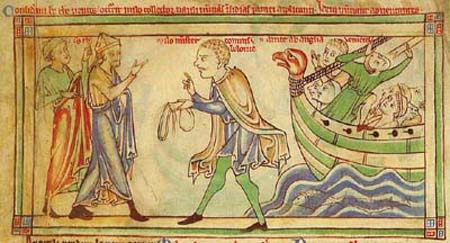
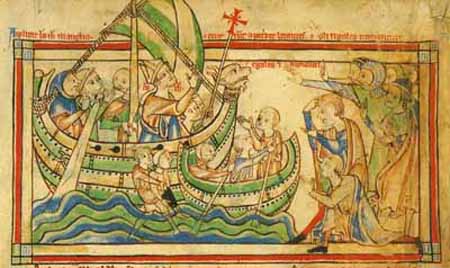
The king was by now increasingly intent on his archbishop's submission. After a final stormy confrontation at another council of barons and bishops held at Northampton in the autumn, Becket escaped to France where he appealed

|
|
for protection to Pope Alexander III, who was then himself living in exile at the cathedral town of Sens. For the next six years the archbishop stayed at the Cistercian abbey of Pontigny while he waged a war of words against his monarch and the latter's new advisers. Most educated churchmen in western Europe would have conceded that Becket had justice on his side in his conflict with the king. However, the functions of Church and State were inseparably intertwined in Plantagenet England: the English bishops were a powerful group who owed their appointments to royal favour and were heavily involved in administrative and judicial work on the Crown's behalf. They therefore had a vested interest in maintaining their crucial role as the leading intermediaries between Church and king and were reluctant to see this prejudiced by Becket's intransigence towards Henry. There was little sympathy for an archbishop who took his opposition to the king to extremes and Becket was gradually forced to realize that his long years of self-imposed exile made remarkably little difference to the running of the English kingdom. According to Bishop Gilbert Foloiot of London, who knew Becket well, 'he always was a fool, and always will remain one'. This judgement on the exiled archbishop is less than fair. However, it is an accurate comment on how Thomas Becket courageously exposed the tensions between the lay and spiritual powers without being able to resolve them -- except by his own death. |
|