|
|
Becket's shrineThere was more than a hint of arson when the choir of Canterbury Cathedral burnt down in September 1174. Bitter arguments had been raging over whether a new one should be built to house the shrine containing the precious relics of St. Thomas Becket and these were decisively settled by the fire. Rebuilding took ten years, and Gervase, a monk at the cathedral priory, wrote a full account of how it was done, describing the way in which a great Gothic cathedral was built. Normally the first step was to raise funds, usually from other ecclesiastical establishments. Canterbury was lucky in that this was not immediately necessary. It was a wealthy see, and the pilgrimage to Becket's tomb has already brought in enormous riches. Even so, work had to be suspended during 1183 while the treasury was refilled. The next steo was to appoint an architect. Several candidates, from both England and France, were invited to Canterbury to discuss their ideas with the monks. A Frenchman, William of Sens, rapidly emerged as the clear victor. William retained the aisle walls of the previous choir, but otherwise build anew. In 1178, he was directing the vaulting of the eastern crossing when he plunged some 50 feet from the primitive medieval scaffolding. Miraculously, he survived. Although he tried to carry on directing the work from his sickbed, ill-health soon forced him to return to France, leaving the choir in the capable hands of |
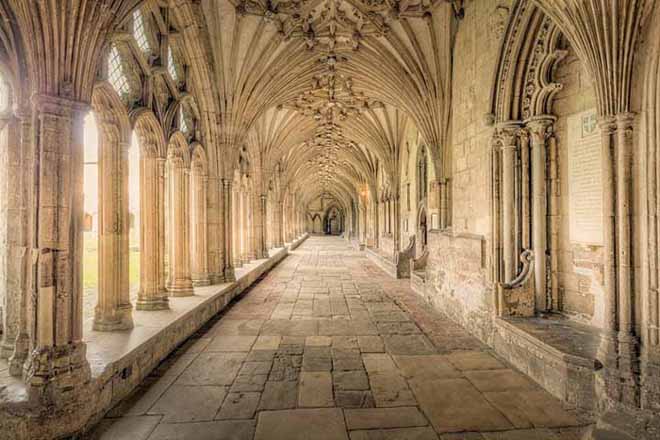
Above This remakable plan for Below The cathedral and cloisters another William, an Englishman, who finished the eastern transepts, extended the crypt, and build the Trinity Chapel and corona. The floor of Canterbury's Trinity Chapel was unusually high to allow the entire congregation to see the shrine, and a broad ambulatory surrounded the chapel's marble piers so that pilgrims could be conducted round the shrine and past the corona, where the scalp of the sainted archbishop was displayed. These arrangements were important: the easier the pilgrims' access to the shrine, the greater their numbers and the greater the gifts of gold and jewels they brought with them. The shrine was not finished and placed in the Trinity Chapel until 1220 -- mainly because of bitter quarrels between King John and Stephen Langton, archbishop of Canterbury -- and the saint's body lay in the old Romanesque crypt, where it had been hastily buried, beneath a provisional shrine. It had already attracted magnificent gifts, including the famous Regale of France, an enormous ruby, given by Louis VII on his visit to Canterbury inf 1179. |
|
|