|
Red Beard
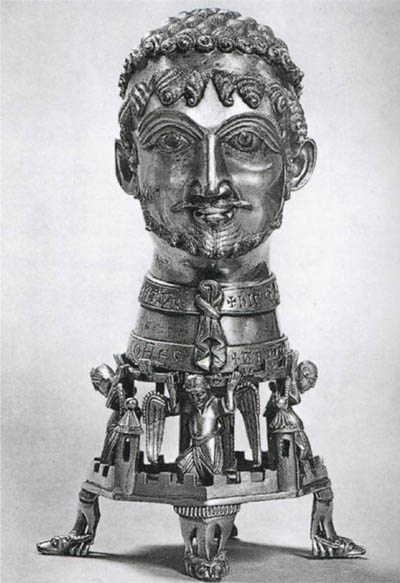
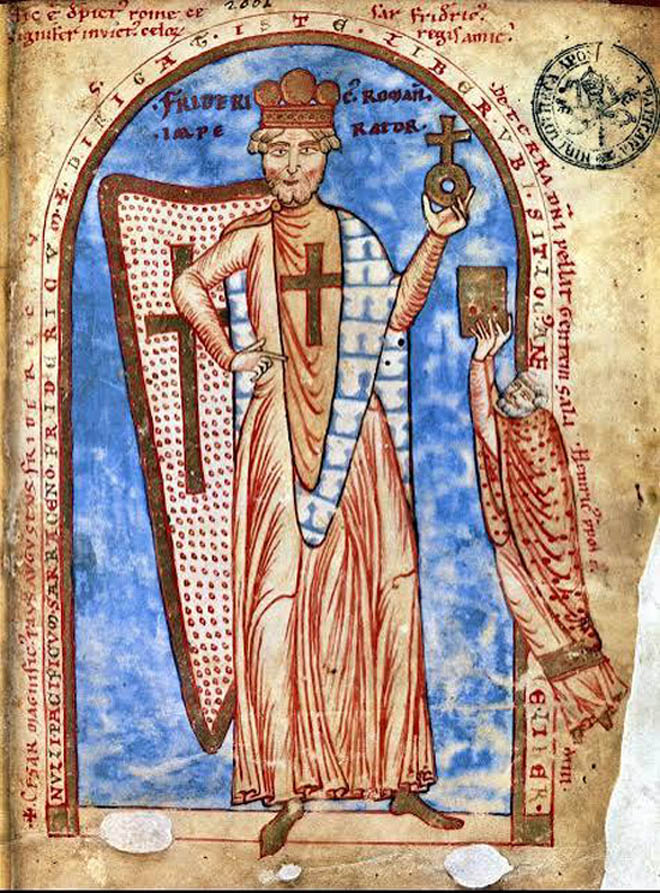
FREDERICK I, Barbarossa, was one of the great medieval emperors. Like Charlemagne five centuries earlier, and Frederick II in the 13th century, he expended tremendous energy on war, travelling and ceremonial in order to maintain his authority throughout far-flung lands. But by 1178 the Holy Roman Emperor was in crisis. Frederick I had been its ruler for 26 years, during which he had first calmed the feuds which had torn his German kingdom apart in the reign of his predecessor Conrad III, then made five military expeditions into Italy in an attempt to enforce imperial authority over its populous, wealthy and independent northern cities which had largely escaped previous emperors' control. He also set up the first of several antipopes in 1159 as a rival to Alexander III.
The cracks in Frederick's grand schemes were opened wide on 29 May 1176 when he was defeated at Legnano by a league of the Italian cities. He was then forced into an apparently diadvantageous settlement with them and the papacy, in the peace of Venice of 1177. This gave cities like Milan and Verona effective self-government within their walls, even though the emperor's overall authority was confirmed. However, it left Frederick free to pursue his German interests more fully. In that kingdom, his
policy of allowing the aristocracy considerable independence in the hope that they would be loyal had crumbled. Henry the Lion, duke of Bavaria and Saxony, was in rebellion and had refused to send troops to Italy for the Legnano campaign. Frederick had relied on him to keep order in Germany, especially in the north where his power was greatest. Frederick was given a suitable pretext in 1178-9 -- a dispute between Henry the Lion and the bishop of Halberstadt -- for trying Henry in his absence in the imperial court and sentencing this great prince to be deprived of his lands. The emperor managed to enforce the sentence and, in 1181, to drive his enemy into exile at the court of Henry II. During the next nine years Frederick I consolidated his successes, married his son Henry to the heiress to Sicily, and went on Crusade, meeting his death in Asia Minor in 1190 soon becoming the focus of myths and legends.
|