
|
The path to holiness
Pilgrimages -- ranging from an individual's visit to the shrine of his local saint to the Crusades -- are remarkable manifestations of the intense popular piety of medieval Christendom. Although the natural desire of men and women to visit holy places believed to be particularly cherished by their god is not confined to the Middle Ages or to Chrisitanity, the widespread belief in the potency of the relics of Christian saints in medieval Europe was exceptional and gave pilgrimages their particular appeal.
With little direct encouragement from Church leaders, the overwhelming majority of clerks and laymen alike came to believe that a visit to a saint's shrine was the equivalent of visiting the person of the saint; the touch, or even the sight of the relics was a sure means of bringing health to the diseased and tranquility to the troubled.
|
|
This pervasive belief in divine intervention led to a flourishing if often dubious traffic in relics, and also to saints' cults growing up in places which later became the great pilgrimage centres of medieval Christendom. From the 11th century onwards, in addition to the prospect of a personal cure, pilgrims had the assurance that their peregrinatio might enable them to atone for past sins and earn some remission from the trials of purgatory. Although Jerusalem and Rome remained the most sacred places in the history of the Christian religion, the popularity of innumerable alternative centres waxed and waned according to how accessible they were and to changing fashions. Pilgrims did not necessarily, or usually, confine their veneration to just one saint. Godric, a merchant from Norfolk (and later a saint) had visited Jerusalem, Rome and St. Andrews, before settling down to become a hermit at Finchale near Durham. He was also one of the first Englishmen known to have made the lengthy journey to Santiago (St. James) de Compostela. A tomb alleged to be that of St. James the Apostle had been discovered in the diocese of Ira Flavia in northern Spain in the 9th Century. As a succession of ever more splendid churches on the site testified, it became the most successful pilgrimage centre of the age and increaing hordes of Christian pilgrims took the long routes de Saint Jacques -- either by sea or land -- to worship at his shrine. |
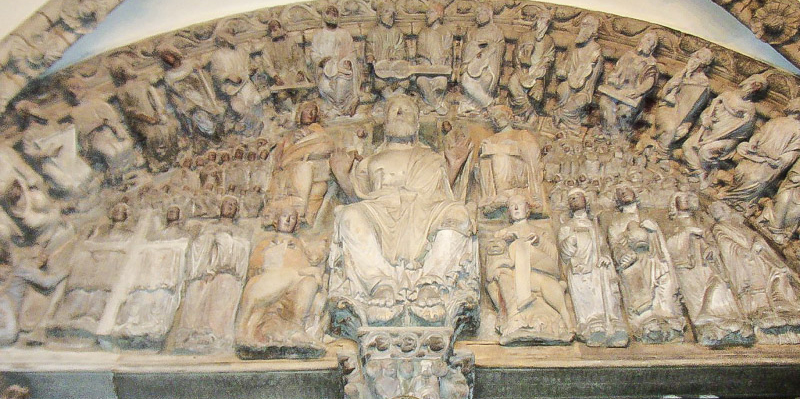
Top left Pilgrims for St Lazare cathedral, Autun. Above The Door of Glory, Santiago Cathedral. Below Medieval Pilgrims, probably to Canterbury.
|
