|

|
Father of the common lawHenry II was a man of wide abilities and considerable learning, and one of his greatest interests was in the workings of the law. Almost fortuitously, he was king of England during a century that saw a revived interest in Roman law and customs and produced flourishing schools of jurisprudence. To anyone well versed in this new learning the English system of customary law, much of it rooted in the Anglo-Saxon period, must have seemed needlessly complex, cumbersome, unreasonable and slow. There were a great many courts of law in England -- royal, country, hundred and borough courts, courts of the feudal honor, manor and village courts, and Church courts held for or by archbishops or archdeacons -- and many had overlapping jurisdictions. A man's status in society and how he held his lands was as important as his alleged offence or the nature of a dispute in determining which court he had to attend. Instead of trying to sweep this morass aside, Henry and his advisers, recognizing that there was some good in the system, took the best elements of what was there and made them work more efficiently. Kings traditionally intervened to remedy complaints that justice had not been done, and Henry did so, in person, on many occasions. The royal court, which sat in the king's absence under the control of his justiciar, met more frequently that before, heard more cases and sent groups of justices to hear more pleas in the shires. Legal changes were made as |
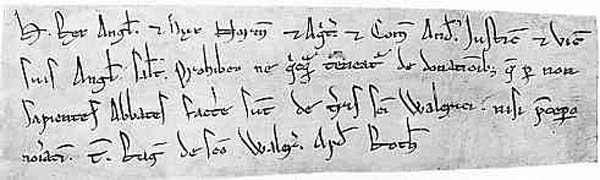
a result of cumulative case law and through assizes -- judicial instructions issued by the king. Traditionally, the truth or otherwise of evidence in a case was established by oath or through ordeal by fire, water or battle. During Henry's reign, the jury of 12 sworn men began to replace this method. One of the most difficult areas of the law involved the possession of land, and the crown standardized the wording and procedures of the writ of right, which ordered lords to do justice in such cases. People unjustly dispossessed of their lands were later given redress through new writs. The most important of these was the writ of novel disseisin, by which a royal justice summoned a jury to establish whether the man bringing the action had indeed had his lands seized and if so by whom. A heavy fine was imposed on the loser. Settlements of land disputes were recorded in the form of final concords or agreements. (The text, if not the use, of these documents continued virtually unchanged into the 19th century.) There is no doubt that Henry II was personally, and sustainedly, involved with these developments. The changes and clarifications which the Plantagenet king and his justices made to the laws of England, and to the procudures through which they took effect, were crucially important to the development of the English legal system. Below left This writ has a title, address, and salutation, Below The castle at Chinon. |
|
|