The cult of chivalry
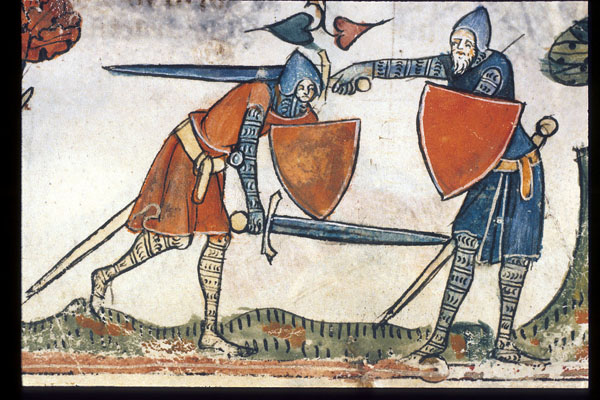
All kinds of men were knights, from individuals who served for pay and in expectation of being rewarded with a grant of land, to the rulers of society -- kings, dukes and counts. They were part of a military elite who practised the art of fighting on horseback with lance grasped firmly under the arm (a technique known as 'jousting'), and shared a common code of values embodied in chivalry -- the French work, chevalerie, means 'cavalry' -- which was celebrated in the vernacular works of the minstrels, the chansons de geste ('songs of deeds') of which the epic Song of Roland is the most famous. The songs extolled loyalty and prowess in battle, strength and endurance, a sense of honour and courtoisie: manners fitting to the court. In return, it befitted a lord to be generous to his followers. Clerics had some success in grafting on other values, such as the protection of the Church, widows and the poor.
The ceremony of initiation into knighthood varied according to wealth and circumstances. A landless younger son was knighted by his father and invested with the arms of knighthood. More elaborate rites were developed for the powerful. An account of the magnificent ceremony in which Henry I knighted Geoffrey the Fair in 1128, on the eve of his marriage to Matilda, tells how, after a purifying bath, Geoffrey was dressed in a tunic of cloth of gold and a purple cloak. The king then bestowed on him symbols of knighthood: golden spurs, a renowned sword and an emblazoned shield. Thirty of Geoffrey's companions were knighted at the same time, and the feasting and tournaments that followed lasted for a week. His grandson, Henry the Young King, was given a 'tutor in chivalry', William Marshal, who knighted the youth in 1173 on the eve of his first campaign (against his father!).
There is a temptation to dismiss chivalry as a romantic ideal, and to some extent it was. Yet the deeds of fictional heroes were emulated in life and beneath tales of knight-errantry lay a sense of realism. The 'Story of William Marshal' -- written in 1225-6 in Anglo-Norman verse by an unknown poet, John -- shows great admiration for William, who seems to have been a genuinely honourable and chivalrous person, and tells how a career devoted to chivalrous deeds was not confined to the chansons.
|

|