
|

|
Words and images
Illuminated manuscripts were the coffee-table books of the Middle Ages and, at a time when only a minority of writings were lavishly illustrated, were almost invariably for special use: a bible or psalter for the church or refectory lectorn, or a diplomatic gift from a baron to his lord, a church to its patron, or from one monarch to another. Most books produced in the 12th century were religious, mainly bibles and psalters, with some biblical commentaries and lives of the saints. Of the secular books, bestiaries seem to have been fashionable towards the end of the 12th century and scientific books, derived from Latin or Greek sources via the Moslems, included herbals, and astronomical and medical treatises.
Although the Church had a virtual monopoly of book production, not all the illustrators were monks; many were versatile artists involved in other, quite different
Top left One of the many delightful illuminated letters in the Winchester Bible. This was probably commissioned by Henry of Blois in 1160, and at least five artists worked on it over a period of about 20 years; but, like many large projects which outlived their patrons, it was never finished.
Left An ivory and velour book cover of the 12th century. The covers of workaday manuscripts were usually made from leather-covered oak boards; but the most precious books, and especially those fully illuminated for religious houses or commissioned by wealthy persons, or intended as personal psalters, could be magnificently ornate, with gold and metalwork filigree, jewelled inlays, and decorative panels of ivory.
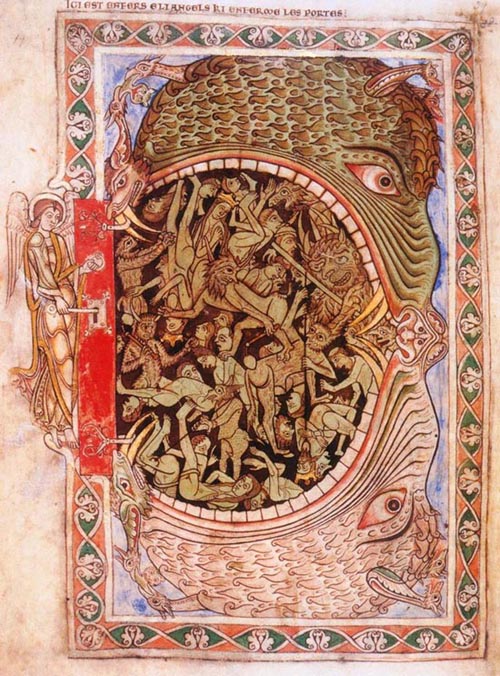
Right Henry of Blois was a leading patron of the arts in England and France. This cover, from a psalter made for his use, is marvellously decorated with a painting of the horrors of damnation, and a view into Hell. The highly imaginative treatment, with its gaping mouth, and rather sad angel locking in the wicked, is one of the finest examples of the period. Even the devil's horns are decorated with dragon ears. It is perhaps a sign of piety or of political astuteness that two of the figures in Hell are a crowned king and queen.
enterprises. Master Hugo of Bury St Edmunds, who painted the Bury Bible, also produced sculpture and metalwork.
One of the artists who illustrated the Winchester Bible was equally at home working on a large scale: he painted frescos in Winchester Cathedral and at Sigena in Spain. An artist of international stature, he had learned his distinctive, Byzantine style in Sicily.
The scribe and the painter-illuminator were sometimes one and the same person. The monk Eadwine of Canterbury was both, and drew a magnificent picture of himself at his writing desk in what is now known as the Eadwine Psalter. Produced at Canterbury in c.1160, it is a copy of a famous Carolingian Psalter, the Utrecht Psalter, which was at Canterbury Cathedral in the 12th century and shows how closely and carefully medieval illustrators copied older models. It also has bound into it a plan of the waterworks installed at Canterbury in the 1160s by Prior Wybert, showing the 12th-century choir before it burned down in 1174.
|